


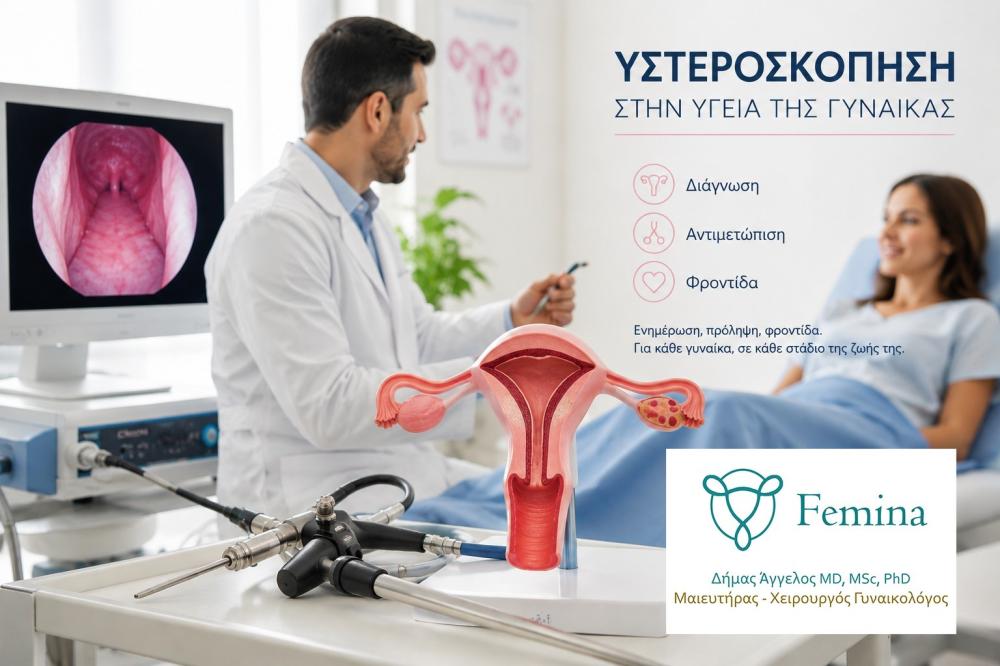
Hysteroscopy is a safe and particularly useful examination for the diagnosis and treatment of diseases of the endometrial cavity. With the help of a thin optical instrument, the hysteroscope, the gynecologist can accurately examine the interior of the uterus, identify pathological findings and, when necessary, proceed with immediate invasive treatment.
At Femina in Preveza, hysteroscopy is performed with scientific precision, discretion and the aim of correct diagnosis, personalized treatment and improvement of the patient's symptoms.
When is it needed?
Hysteroscopy is indicated for patients with:
• Menorrhagia or hypermenorrhea.
• Abnormal uterine bleeding, especially when it persists or is not explained by other tests.
• Suspicion or presence of an endometrial polyp.
• Suspicion of submucosal fibroid.
• Endometrial hyperplasia or need for targeted biopsy.
• Infertility or recurrent miscarriages, when examination of the endometrial cavity is required.
• Incompatible or inadequate results of other imaging or diagnostic tests.
What does it detect and why is it important?
Hysteroscopy allows for direct visual assessment of the endometrial cavity and helps in the diagnosis of polyps, fibroids, adhesions, congenital anomalies, endometrial hyperplasia, endometrial cancer and other pathological conditions. Unlike indirect tests, it allows for targeted assessment and, when required, a combination of diagnosis and treatment in the same session.
It is an important tool for the timely and accurate investigation of the cause of bleeding or other symptoms, thus contributing to the correct treatment and monitoring of the patient.
What does the examination include?
Hysteroscopy is performed in a properly organized surgical environment and, depending on the type of procedure, includes the following sequential steps:
• Taking a history and informing the patient about the procedure.
• Brief preoperative check-up with blood tests and assessment by a specialist Cardiologist
• Assessment by a specialist Anesthesiologist and administration of mild anesthesia
• Entry of the hysteroscope through the cervix into the endometrial cavity, without incisions.
• Immediate overview of the endometrial cavity under magnification and illumination.
• Dilation of the cavity with appropriate fluid, in order to achieve clear visibility.
• In the diagnostic phase, identification of possible pathological findings and taking a targeted biopsy when deemed necessary.
• In the invasive arm, the possibility of removing endometrial polyps, lysis of adhesions, removal of submucosal fibroids or other endometrial lesions, depending on the finding and indication.
• Examination time: approximately 10–30 minutes for simple diagnostic hysteroscopy, while invasive hysteroscopy may take longer, depending on the procedure.
• Pain: usually mild discomfort or cramps due to uterine distension. Analgesia is always administered although in many cases it is not required.
Diagnostic hysteroscopy
Diagnostic hysteroscopy allows for detailed examination of the endometrial cavity and the taking of a biopsy from suspicious areas. It is used when there is a need for an accurate diagnosis of the cause of bleeding or for the evaluation of pathological findings that cannot be adequately assessed by ultrasound or other tests.
Targeted biopsy through hysteroscopy increases diagnostic accuracy, especially when the lesion is localized, such as in the case of a polyp or focal endometrial lesion. It has been the diagnostic test of choice for the last 15 years for pathological conditions of the endometrial cavity.
Interventional hysteroscopy
Interventional hysteroscopy allows for the simultaneous treatment of uterine diseases, usually without the need for major surgical intervention. With the help of special tools, the following can be performed:
• Removal of endometrial polyps.
• Excision of submucosal fibroids.
• Dissolution of endometrial adhesions.
• Targeted removal of pathological endometrial tissue.
• Taking multiple biopsies when histological documentation is required.
Interventional hysteroscopy often reduces the need for more extensive surgery and contributes to faster recovery and better management of symptoms.
Results and next steps*
• The findings of the hysteroscopy are explained in detail to the patient immediately after the examination.
• When a biopsy is taken or tissue is removed, the material is always sent for histological examination to a specialized pathology laboratory at Hygeia Hospital and is evaluated by highly trained Pathologists.
• The response time for the histological examination is usually 2 weeks.
• Based on the results, the next step is discussed, which may include monitoring, medication, repeat examination or further therapeutic procedure.
Why choose Femina in Preveza for your hysteroscopy?
Our experience in diagnosing and treating endometrial and uterine diseases, combined with a modern approach and personalized care, ensure a high level of service, correct assessment and safe decision-making for each patient.
At Femina in Preveza, we have as our guiding principles:
• The specialized and personalized approach to each patient.
• The safe and as painless as possible conduct of the examination.
• Full information before, during and after the procedure.
• Immediate treatment of pathological findings when this is possible and appropriate.
• The preparation of an individualized monitoring and treatment plan.
Frequently Asked Questions (FAQ)
• Does hysteroscopy hurt? Usually not particularly. There may be mild discomfort or cramps that are effectively controlled with simple painkillers.
• Is anesthesia needed? In the majority of cases, yes. Diagnostic hysteroscopy is an examination that, under certain conditions, can be performed without anesthesia, but due to possible complications, anesthesia is preferred. Interventional hysteroscopy almost always requires anesthesia and analgesia.
• How long does it take? Usually 10–30 minutes for the diagnostic examination. The interventional one may take longer.
• Is there any preparation required? You may be given specific instructions depending on your cycle, history and the type of test.
• When will I get the biopsy results? Usually within 2 to 3 weeks at most.
Book your appointment today
For a hysteroscopy, call our office to book an appointment. At Femina you will receive the support you need from a team experienced and dedicated to women's health.
Back